
One developer. The output of an entire team.
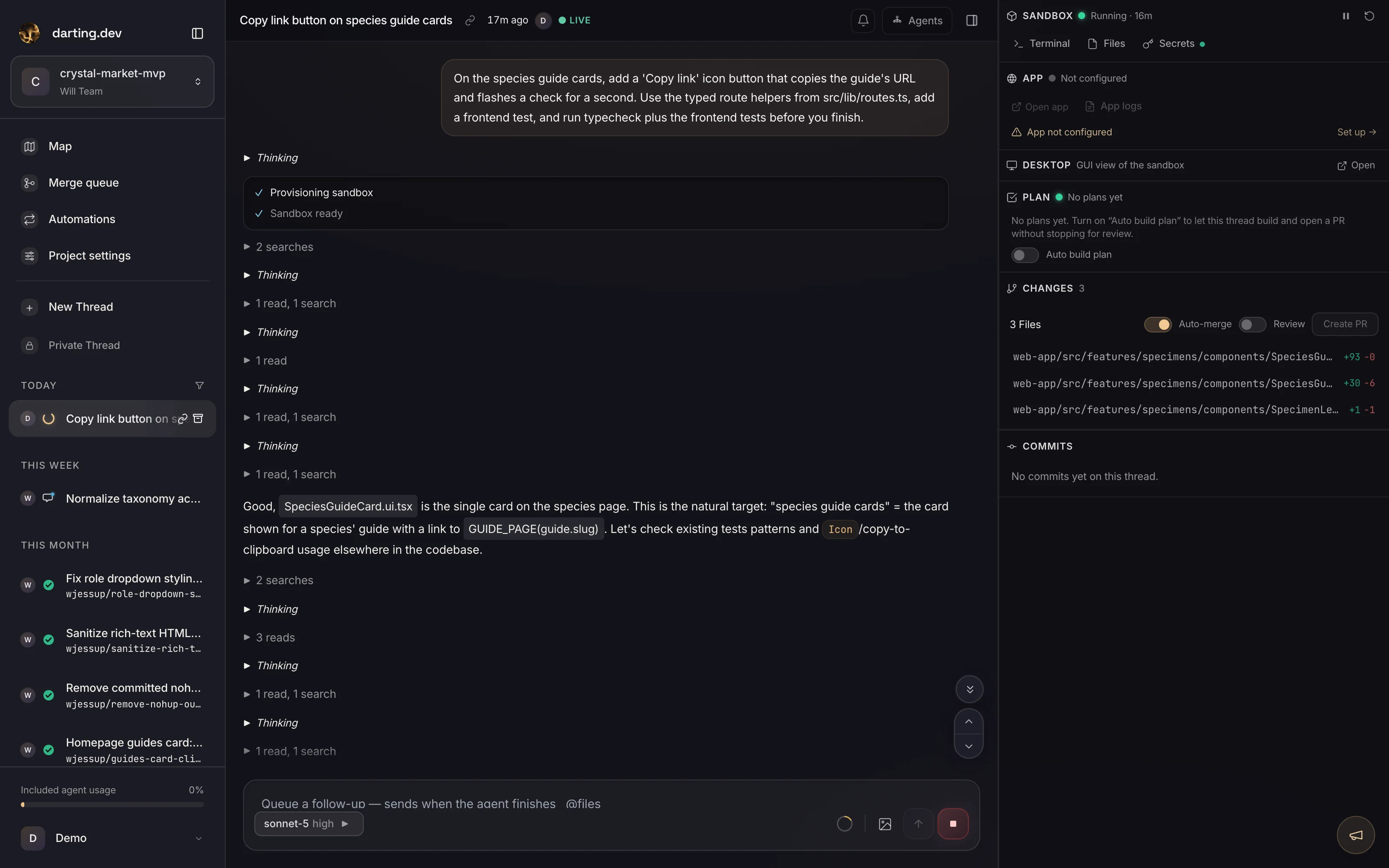
Point it at a GitHub repo and your project runs in the cloud — nothing on your laptop. Open it from your phone, invite your whole team. No engineering experience required.
The bottleneck was never your typing speed. It was doing one thing at a time — and that just ended.
Every coding tool is missing something
No worktrees here, no done-notifications there, forks missing somewhere else. Those aren't missing features — they're symptoms of the same dead end: one IDE, one working copy, one thread at a time.
- One working copy — parallel agents juggle worktrees, forks, and dev-server ports
- You babysit every thread to find out when it's done
- Merging is manual, and conflicts are your problem
- Plans and docs go stale the moment main moves
- Context lives in one chat window — close it and it's gone
- Every thread gets its own cloud sandbox and branch — twenty at once, zero collisions
- The map and HUD surface what shipped, what's running, and what needs your orders
- A smart merge queue lands green PRs on main by itself
- Plans re-version themselves as the code moves underneath
- A shared knowledge base every agent reads, kept current automatically
Everything that breaks at twenty agents, already handled
Sandboxes that never collide, CI that repairs itself, shared knowledge that stays current, and setup your whole team inherits for free.
Sandboxes that never collide
Every thread works in its own isolated cloud sandbox on its own branch, so one thread's edits can never break another's test run. Parallel work never trips over itself — no phantom failures, no wasted time or spend.
CI that fixes itself
When checks go red, the thread reads the failing job's logs and pushes a fix, then waits for the next run. Twenty agents means twenty times the CI failures — none of them yours to triage.
Your company brain
A background agent reads your codebase and writes a knowledge base — architecture, data model, conventions, the security model — that every agent is grounded in and your whole team shares. It stays current as the code changes.
Setup once, for everyone
Configure the project a single time and it's captured as a snapshot every future thread boots from — warm, installed, ready. Teammates join with nothing to install: no worktrees, no .env to copy, no ports to remember.
Context you can see
Nothing hidden behind a black box. Inspect, debug, and shape exactly what each agent knows — watch context get assembled, write your own agents, keep project knowledge sharp.
Git-native, always in sync
PRs open and stay current automatically. When a teammate merges to main, every thread sees how far behind it is and updates in a click — so work never drifts out of date.
From prompt to pull request in four steps
- 01
Create a project
Paste a git URL, start from scratch, or connect a repo later. The sandbox clones and boots it for you — no worktrees, no .env copying, no ports to remember.
- 02
Describe the outcome
Chat with the lead agent. Simple asks get done directly; complex work becomes a living plan you review and Build when ready.
- 03
The swarm works in isolation
Threads fan out across separate sandboxes — building, running tests, and validating the UI like a human, none ever breaking another's run.
- 04
Watch the proof, then merge
Review video summaries and branch-aware diffs, then open a PR. Arm auto-merge when you're ready — green CI lands it without you babysitting.
Start free. Scale when the swarm does.
A generous free tier to try it, usage-based plans as your agents take on more.
Ship your next feature with a swarm
Spin up your first project in under a minute. Bring a git repo or start from an empty one.